Filth and Exploitation
What separates Pink Flamingos from other Shocking Cinema

Trigger warning: the following essay discusses controversial cinema, and Pink Flamingos in particular. A film that contains the following: coprophilia, forced insemination, abduction, sexual exhibitionism, anal prolapse, cannibalism, murder, castration, human trafficking, and incest.
"The filthiest people alive?" Well, you think you know someone filthier?—The narrator of Pink Flamingos on Divine/Babs Johnson
I think I first heard about Pink Flamingos when I was about ten or so. I was going to a film camp in Baltimore and I saw a stand that featured Divine in her famous red dress, pistol held out in front of her. Like a Valkyrie in a garish dress and even more garish make-up. Naturally, I was intrigued. I think the most description I got of the film at the time was that it was “a movie.” As the years went on, however, I learned more and more about the film. Specifically, it was one of those movies. You know the kind. Films that are famous less because they are memorable pieces of narrative art and more because they serve as endurance tests for the audience. Films like Cannibal Holocaust, Hostel, Audition, Come and See, and Human Centipede. Films where the director seemed dead set on sickening the viewer to the best of his (and it usually is a “he”) ability. I also learned about its most infamous scene: when star Divine picks a dog turd up off the ground and eats it. Yeah… If there’s a word for both horrified and fascinated, I think that about summed up my attitude toward the picture.
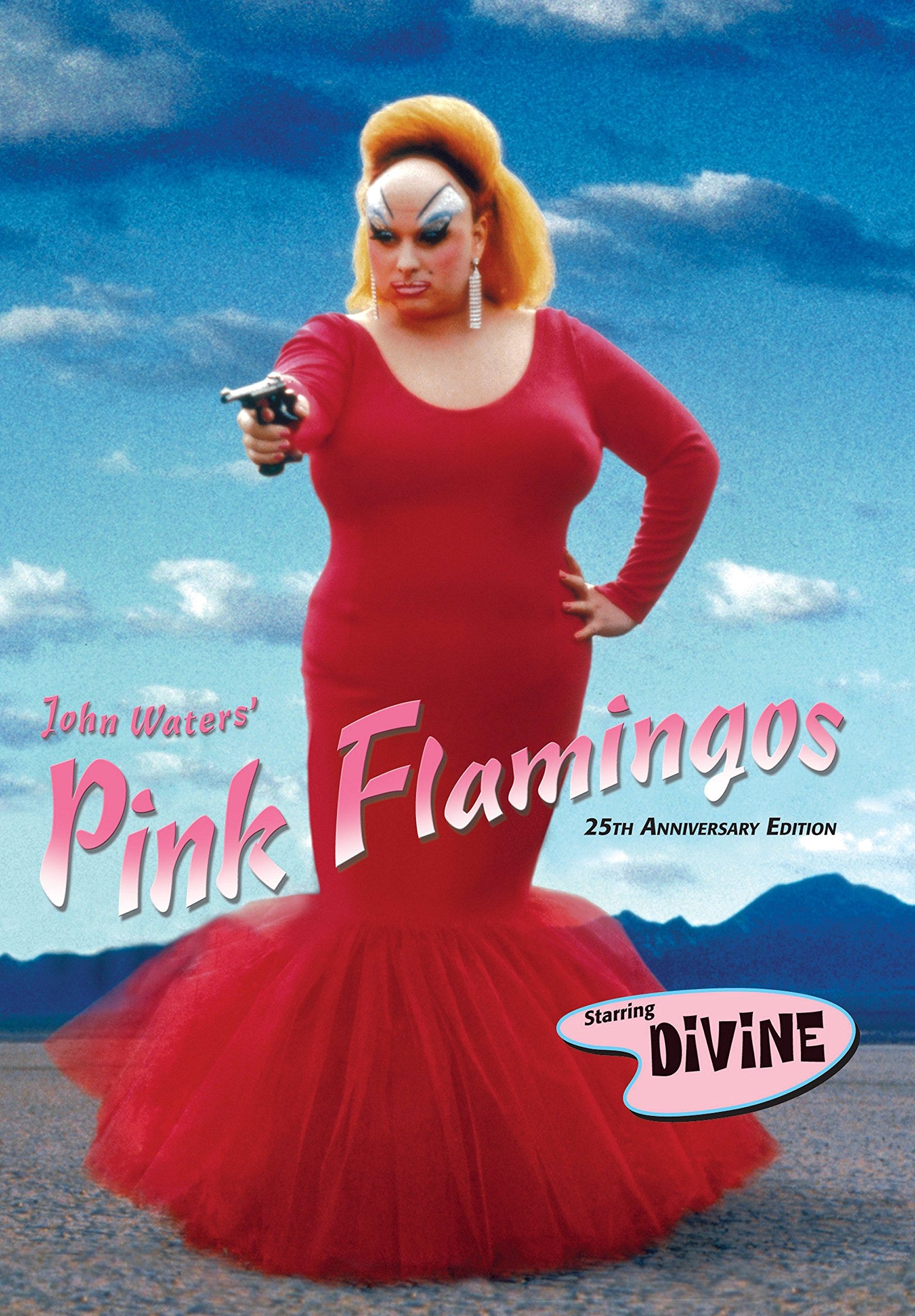
Fast forward to my early thirties and I finally bit the bullet (and that is the only thing I bit) and watch the damned thing. After what had to be one of the more memorable hour-and-a-halfs of my life, I came away with two impressions: one was that Divine’s shit-eating was only the tip of the iceberg; and the second was that, for all of its reputation, there was something very different from other boundary-pushing films that it was often lumped in with. It was only later on, after a bit of thinking and disassociating that it occurred to me why. While a lot of “gross” films have a bit of a cruel streak running through them, Pink Flamingos seemed, dare I say it, wholesome.
If you’re in the unenviable position of not having heard about John Waters’ 1974 classic Pink Flamingos, its about the rivalry between two factions vying for the crown of filthiest person alive. On one side we have the protagonists, the Johnsons (at least that’s what I’ll call them): Divine, aka Babs Johnson, the trash queen herself; Babs’ mother, Edie, a mentally ill woman with an egg obsession; Divine’s son perverted son, Crackers; and Divine’s traveling companion and Crackers’… partner, Cotton. On the other side, you have Connie and Raymond Marble, along with their mistreated manservant, Channing. When the Marbles hear of Divine’s title as grossest person alive, and that the Johnsons are in town, they decide to get to work causing trouble for Babs and company.
All of that out of the way, if you know anything about other gross-out films, like 120 Days of Sodom, or Irreversible, then you’ll have already noticed some distinct differences between those kinds of films and Pink Flamingos. For one, the relationship between protagonist and antagonist. Typically in these films, the protagonist is either kidnapped or their home is invaded by the antagonist.
The shock such films are known for, by extension, comes from graphic depictions the acts of cruelty and humiliation inflicted upon the protagonist, up to and including sexual depravities. Expect to see lots of blood, guts, nudity, and camera shots lingering on the horrified faces of the actors playing the victims. If these films do have happy endings, they usually come in the form of the protagonists enacting their own tortures on their tormentors, tainting even the catharsis we’d usually get from retribution with a thin layer of ick.
The dynamic between the Marbles and the Johnsons, however, couldn’t be any more different. While the Marbles kidnapping young women, forcibly impregnating them, and selling the resulting babies to lesbian couples, none of the Johnsons are victims of this depravity. If Pink Flamingos was like Salo or its ilk, we’d be getting graphic scenes of the Johnsons kidnapping, along with their clothing being ripped off, and graphic scenes of Channing’s “impregnations.” Instead, the Marble’s schemes relating to the Johnsons are almost completely unrelated to their own depravities. The “nastiest” thing the Marbles end up doing to the Johnsons is sending Babs a turd for her birthday.
Instead, the film’s shock comes primarily from the actors almost showing off how gross or weird they are. Crackers and his date having sex in between a chicken, Divine and Crackers… getting very intimate as mother and son, that one scene during the birthday, and, of course, Divine’s famous shit-eating. Conversely, the most overtly shocking thing the Marbles do is when Raymond flashes woman with a literal sausage attached to his metaphorical sausage.
The movie itself isn’t even that bloody, even during scenes that may warrant an excess of blood. Poor Channing gets killed in the worst way possible that someone with a penis could be, and the resulting wound we're isn’t even that bad. Don’t get me wrong. I wouldn’t be surprised if the movie was supposed to be bloodier. If it was, I assume that Waters instead decided to allocate the pittance that was his budget for the essentials—sets, cameras, Divine’s makeup and outfits. Whatever the original plan was, the end result was that Waters couldn’t rely solely on overt brutality for his shock factor. He could only cut away whenever someone was shot or show Divine and co. attacking police but not actually ripping bits and pieces off them.
And, of course, there was the necessity of finding actors willing to do the sorts of gross, ridiculous things Waters required of them. Perhaps one might even say that he had to build a community. While it isn’t out of the ordinary for the cast and crew of a film to form a sort of familial bond during their time together, apparently this was doubly so for Pink Flamingos. From what I’ve read, the trailer that served as the Johnsons’ home for the film was a sort of “hippie commune,’ and the living quarters didn’t have hot water. Speaking from experience, in that sort of situation, you’re going to either hate or love your companions, and something tells me that it was the latter case.
This sense of community manages to leak into the film itself. You get a feeling that the Johnsons and their various friends have a certain level of camaraderie. The other Johnsons seem to genuinely care for Edie, in spite of her condition, talking with her and feeding her as many eggs as she wishes. Crackers even introduces his dear grandmama to the woman he’s about to have chicken sex with. And while the Johnsons may be hostile to outsiders—just ask the mailman who somehow knew how to find them abode despite what had to be the least specific directions in human history—they do seem to care greatly for their friends and community. Edie even marries the egg man who drops by their place to give her those precious packages of protein and cholesterol. And while Babs may threaten to eat a particular paparazzi’s family, she’s generally pretty open and patient with the news-hawks that come to view her kangaroo court. Hell, it could even be argued that the disgusting things Babs and co do are solely out fun. The whole dynamic reminds me of the film “Freaks,” a film that used performers with actual physical abnormalities for their cast. There is a genuine sense of community amongst the dwarves and folks with missing limbs that you can’t help but be just a little envious.
This generally positive and almost easygoing attitude I think is what separates Pink Flamingo’s shock factor from many a “torture porn” picture. Where most shock films have an edge of cruelty to their shocking content, most of Pink Flamingo’s shocking scenes feature people, dare I say it, showing off. Like that one guy at the school cafeteria who would snort a piece of spaghetti and sort of “floss” accursed foodstuff through his nose and mouth. You get a feeling that the trick wasn’t easy for the nut-case to master, but that the looks of both admiration and disgust that people give him is worth it. As vile a film as Pink Flamingo is, it’s also, in a weird way, kind of fun. And not in a sadistic way, either. As grossed out as we are by John Waters’ opus, we’re also impressed, and, dare I say it, a little envious.
Reminiscing on Pink Flamingos after a recent rewatch, I’m reminded of an anecdote from Roger Ebert’s review of the 25th-anniversary release of the film about a geek (freak) who’d bite the heads off of chickens and drink their blood. The man was, according to an unnamed third party, the best geek in the business. Ebert asks the other man what the difference between a good geek and a bad geek is. The answer Ebert got was do “you wanna examine the chickens.” And I think that is at the heart of both the appeal and earnestness of the film, at least when compared to other shock films. A good geek bites off the chickens head. A bad geek would either use a fake chicken or force someone else to eat the chicken in their stead. And neither would be as horrifyingly fascinating as someone eating an actual chicken head. They would just be horrifying. Where so many films are cynical in their attempts to shock, Pink Flamingos puts actual, proper heart and soul into its shocking content. There is no reluctance from the geek, just a sense of satisfaction at being an expert in the disgusting.
I am reminded of an interview I once did with a man who ran a carnival sideshow. His star was a geek, who bit off the heads of live chickens and drank their blood.
“He’s the best geek in the business,” this man assured me.
“What is the difference between a good geek and a bad geek?” I asked.
“You wanna examine the chickens?” “Pink Flamingos” was filmed with genuine geeks, and that is the appeal of the film, to those who find it appealing—the aforementioned Ebert quote.
If you’re interested in watching Waters’ epic, then I have bad news. Because we can’t have nice things, the film isn’t available on streaming. You can’t even rent it digitally. Outside of going the Jack Sparrow route, the best way to find the film is to buy it from Amazon or some other popular seller. If you live in a relatively big city, the best ways to see the flick without lining Jeff Bezo’s pockets even more is to see if you can find an old fashioned video rental store. In Atlanta, for example, there’s a place called Videodrome, your go-to place to pick up pictures both obscure and neglected by streaming services. Another route is to try ask if your local library would be willing to hunt down a copy for you. Hell, even if you’re not interested in Pink Flamingos, I’d recommend going to either places like Videodrome or your local library. If nothing else, supporting those sorts of places keeps the metaphorical Marbles of the world from making more money than they already have.